Remote medical collaboration is no longer a promise. The Health Revolution Congress 2026 confirmed it.
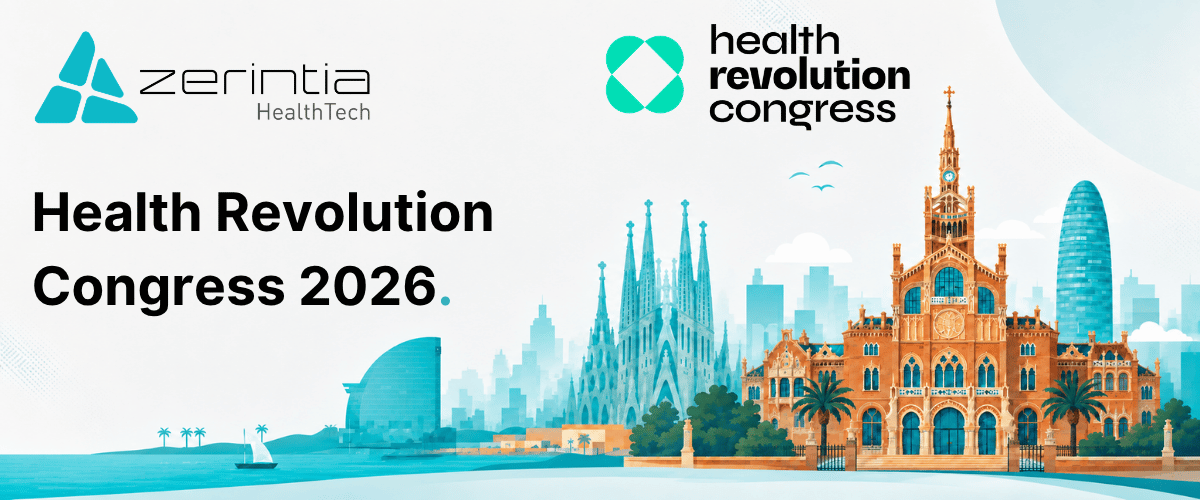
In May 2026, Zerintia HealthTech attended the Health Revolution Congress (HRC), held at the Recinte Modernista de Sant Pau in Barcelona. Over 3,000 professionals, startups, hospitals, and investors gathered for two days to debate what is transforming healthcare delivery across Europe.
As members of Barcelona Health Hub, participation in the HRC is more than a networking opportunity — it’s a real-time read on where the sector actually stands. In this context, what the congress made clear is that remote medical collaboration has moved from emerging trend to operational necessity for any healthcare organization serious about quality of care.
A congress that speaks the same language
The HRC 2026 agenda reflected this shift. Sessions covered artificial intelligence in clinical settings, new primary care models, and coordination across care levels.
However, what stood out wasn’t the technology itself — it was the consensus in the room: clinical teams need tools that allow them to work together regardless of where they are.
Fragmented care delivery remains one of the biggest barriers to quality healthcare, and physical distance makes it worse.

The problem the sector has been trying to solve for years
One of the most recurring themes in conversations throughout the congress was the gap between available technology and its real adoption in clinical environments. In practice, medical teams are still coordinating through channels that were never designed for it: phone calls, informal messages, emails lost in overloaded inboxes.
Clinical coordination at distance requires more than video calls. It requires structured clinical workflows, traceability, secure handling of sensitive data, and an experience built specifically for healthcare professionals — not repurposed from generic enterprise tools.
That’s the problem 4RemoteHealth solves: by bringing together in a single session medical device signals, remote healthcare professionals, and tools for augmented reality and AI-assisted automatic translation — among many other features designed for real clinical environments.
As a result, clinical teams become more connected and patient care becomes more efficient.
Three takeaways from HRC 2026
First, technology is no longer the bottleneck. The solutions exist. The real challenge is getting clinical professionals to adopt them in their daily workflows without adding friction — without steep learning curves or endless onboarding.
Second, regulation is not just a compliance issue. What was heard in Barcelona was clear: organizations that integrate regulatory requirements from the start of product development reach the market faster and with greater confidence. It’s not a barrier — it’s a competitive advantage when managed well.
And the third, perhaps the most structural: the sector cannot move forward in silos. Hospitals, startups, insurers, and research centers need to talk to each other — and in Barcelona, it was clear that conversation is already happening.
For Zerintia HealthTech, these three takeaways are more than observations. They’re the roadmap behind the development of 4RemoteHealth.
Is distance still getting in the way?
If remote clinical coordination between professionals is still a weak point in your hospital, care network, or clinical team, 4RemoteHealth can help.
Request a demo or contact the Zerintia HealthTech team.
